Lady Macbeth has had a rough life and deserves to chill for a bit. Here are some great shows on Netflix that she could soak up in the sun of Scotland:
The Office would be a great show for a character like Lady Macbeth. This would be a magical show for her to lay back and relax to watch, maybe even get a little laugh out of it here and there. This show is a comedy about a paper company that is based in the city of Scranton, Pennsylvania. There are many different characters that could appeal to many different people all over the world but in Lady Macbeth's case, there is only one character that would fit the bill. She would love to watch Jan Levinson, the boss of Michael Scott. She appreciate her character because of the constant need for babysitting she has to deal with when interacting with Michael. Jan constantly has to encourage and support Michael to get his work done which is very similar in the way that Lady Macbeth has to urge Macbeth to go forward with certain tasks. Overall, I think that Lady Macbeth would enjoy the subtle humor of this hilarious show but also find a strong sense of connection to the character of Jan Levinson.
Parks and Recreation would also be a great show to watch for a woman such as Lady Macbeth. This show could spark a little political interest from Lady Macbeth while also giving her a rough case of the chuckles. This show is also a comedy about a parks department in Pawnee, Indiana just trying to get by everyday. More specifically, it is about a woman who the leader of this parks department and how she lives out her life as a servant to the Indiana government. This woman's name is Leslie Knope and she takes her job very seriously and never takes a minute off. She is fully committed to making Pawnee a better place and will do whatever it takes to make sure that she is doing the best she can. Lady Macbeth would like this show because not only is it a woman rising in power in politics, but Leslie constantly has to make up the slow pace of her male constituents. This is easily something that Lady Macbeth can relate to with her rise in power to the Queen of Scotland along with the ever growing amount of effort she has to give to make her husband look and act the best he can. Overall, I think that Lady Macbeth would very much appreciate the struggle that Leslie Knope faces being a woman in politics and also giggle a little bit at the sheer craziness that Leslie has to deal with every single day.
The next show that I would recommend for Lady Macbeth would be The Blacklist. This show is much different than the previous two that I have given for Lady Macbeth to watch. While the other two are more of sitcom comedies, The Blacklist is an action packed thriller that stars a female lead. Elizabeth Keen, an FBI agent, is paired up with one of America's most dangerous criminals after he turns himself in and specifically requests only talking to her. This show follows their relationship through many different cases and analyzes the power dynamic between the two as the show progresses. Lady Macbeth would find this show interesting because of the parallels that it has to her own life. First being how Elizabeth goes from just a FBI profiler to talking to the the most wanted criminal in the United States. This same power shift occurred with Lady Macbeth becoming the Queen of Scotland. Also Elizabeth Keen is someone who does not back down from anyone and has a bit of an attitude about her at times which Lady Macbeth can definitely relate to. Overall, this show presents a woman in a power role at a prominent crime organization in the FBI and that is something that Lady Macbeth could get hooked on for sure.
The fourth and final show that I think Lady Macbeth would be down to watch is the Last Chance U which is a Netflix original series. Now I know that a sports documentary series would seem like a stretch for Lady Macbeth but in a weird way it does work. First of all, it is about East Mississippi Community College and the journey that their football players go through every day. The documentary goes very in depth into the individual stories of each of the player like where have they been and their plans for the future. It also shows what happens outside and off the football field which most of the players struggle with, the academics. The lady that is in charge of making sure the players are NCAA eligible or even passing, also known as the academic advisor, is Brittany Wagner. This is where Lady Macbeth would find interest in this show because of the job that Ms. Wagner is serving for these boys. She cares for them like they are her own children which is something that Lady Macbeth would envy because she never had any kids. Also she still has to keep them in line and give them some tough love when they are struggling to get the grades they need to accomplish their goal. This is something that Lady Macbeth could relate to in a much different way with having to keep Macbeth in line and keeping his eyes focused on the goal that was at hand which was to become king. Overall, I think this is the weakest of the four suggestions but I still think it shows some potential for Lady Macbeth to show interest in the care and tough situations that Brittany Wagner is faced with in the documentary as a whole.
You are welcome Lady Macbeth, Enjoy.
What's cookin' good looking'!
Sunday, December 18, 2016

Sunday, December 4, 2016
People don't think it be like it is, but it do: Last Minute Winner Part Tres
1. Why do people who are not "evil" take the first step into evil? What, for instance, is involved in taking that first step "down the primrose path to the everlasting bonfire" (Macbeth, 2.3)? What are the consequences of the individual choosing evil (particularly the internal consequences)? Use examples from the text to support your opinion.
Taking a step towards evil, I believe, is not something that you do yourself. The idea of evil is something that actively seeks out its prey. It is almost as if evil is a predator in the jungle of life and it picks and chooses who it wants to affect. Once affected, it is a disease that takes over your entire body and consumes about every facet of saneness you had inside you. All in all, Evil is something that definitely infects you negatively and changes the way you make decisions and live out your life.
Being the "doctor" that has been assigned to the play, MacBeth, I have diagnosed the former noble war hero of MacBeth with the disease of evil. He was infected with this deadly disease in multiple ways, the first symptom being through the supernatural aspects that are apart of his world. This is specifically in the first act, when three witches had been encountered with MacBeth and Banquo and they told the two their prophecies. MacBeth's included him becoming king and the successor of King Duncan, with the third witch stating "All hail, Macbeth, thou shalt be king hereafter![…] Thou shalt get kings, though thou be none. So all hail, Macbeth and Banquo!" (Shakespeare 1.3;70-71). MacBeth, being a virtuous man with a good moral compass was not so sure of this so called prophecy and did not know if he was the man to carry it out. This was quickly changed when the second major symptom came into to play, Lady MacBeth. Lady MacBeth was much more committed to this prophecy and was definitely an influence to the way MacBeth acted. This is apparent when the two lovers are discussing the whole situation and MacBeth asked "If we should fail?"(Shakespeare 1.7;59-61) and Lady MacBeth responded with "We fail? But screw your courage to the sticking place, And we'll not fail" (Shakespeare 1.7;59-61). She was his significant other and she was basically daring him to become more of a man, so of course he was going to listen to what she wanted. This nudge was all he needed to fall further into the disease of evil and that is when he started to feel the full force effects.
Further into the play, MacBeth and Lady MacBeth devise a plan for him to become king. In this plan, MacBeth had to murder King Duncan cold blooded along with hiring murderers to end the life of his dear friend Banquo. This sent MacBeth not only into a spiraling staircase of guilt but also caused him to go into a state of insanity. He had not only lost the honorable man he once was but had also started to lose his mind. His mind was definitely not all with him during the dinner party that took place in the third act. He had walked into the party with Lady MacBeth where all of this noblemen were seated around the table but MacBeth could not sit down. He had hallucinated the ghost of Banquo in his seat and he could not shake the sight of him. When his noblemen asked him to sit down, the royal kings response was "The tables full" (Shakespeare 3.4;48), referring to Banquo's ghost in his seat. This was one of the major consequences that he faced because of the misguided, horrifying decisions that he had made to try to fulfill his prophecy.
At this point in the play, MacBeth had lost almost all of his sanity due to the disease of evil that he had caught much earlier in proceedings. The disease had taken over his mind and controlled not only his decision making but started to take over his senses. He was a completely different man and not even his own wife could snap him t of this state. Evil is a disease that is not always common in people, but once caught, it is something that can ruin everything good you had ever had in your life or at least make you think that everything you are doing is for the better, when in reality, you are just making everything so much worse.
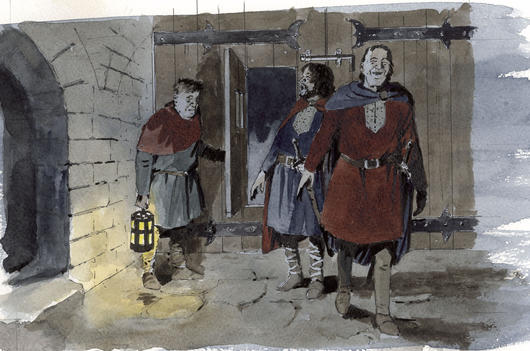
Taking a step towards evil, I believe, is not something that you do yourself. The idea of evil is something that actively seeks out its prey. It is almost as if evil is a predator in the jungle of life and it picks and chooses who it wants to affect. Once affected, it is a disease that takes over your entire body and consumes about every facet of saneness you had inside you. All in all, Evil is something that definitely infects you negatively and changes the way you make decisions and live out your life.
Being the "doctor" that has been assigned to the play, MacBeth, I have diagnosed the former noble war hero of MacBeth with the disease of evil. He was infected with this deadly disease in multiple ways, the first symptom being through the supernatural aspects that are apart of his world. This is specifically in the first act, when three witches had been encountered with MacBeth and Banquo and they told the two their prophecies. MacBeth's included him becoming king and the successor of King Duncan, with the third witch stating "All hail, Macbeth, thou shalt be king hereafter![…] Thou shalt get kings, though thou be none. So all hail, Macbeth and Banquo!" (Shakespeare 1.3;70-71). MacBeth, being a virtuous man with a good moral compass was not so sure of this so called prophecy and did not know if he was the man to carry it out. This was quickly changed when the second major symptom came into to play, Lady MacBeth. Lady MacBeth was much more committed to this prophecy and was definitely an influence to the way MacBeth acted. This is apparent when the two lovers are discussing the whole situation and MacBeth asked "If we should fail?"(Shakespeare 1.7;59-61) and Lady MacBeth responded with "We fail? But screw your courage to the sticking place, And we'll not fail" (Shakespeare 1.7;59-61). She was his significant other and she was basically daring him to become more of a man, so of course he was going to listen to what she wanted. This nudge was all he needed to fall further into the disease of evil and that is when he started to feel the full force effects.
Further into the play, MacBeth and Lady MacBeth devise a plan for him to become king. In this plan, MacBeth had to murder King Duncan cold blooded along with hiring murderers to end the life of his dear friend Banquo. This sent MacBeth not only into a spiraling staircase of guilt but also caused him to go into a state of insanity. He had not only lost the honorable man he once was but had also started to lose his mind. His mind was definitely not all with him during the dinner party that took place in the third act. He had walked into the party with Lady MacBeth where all of this noblemen were seated around the table but MacBeth could not sit down. He had hallucinated the ghost of Banquo in his seat and he could not shake the sight of him. When his noblemen asked him to sit down, the royal kings response was "The tables full" (Shakespeare 3.4;48), referring to Banquo's ghost in his seat. This was one of the major consequences that he faced because of the misguided, horrifying decisions that he had made to try to fulfill his prophecy.
At this point in the play, MacBeth had lost almost all of his sanity due to the disease of evil that he had caught much earlier in proceedings. The disease had taken over his mind and controlled not only his decision making but started to take over his senses. He was a completely different man and not even his own wife could snap him t of this state. Evil is a disease that is not always common in people, but once caught, it is something that can ruin everything good you had ever had in your life or at least make you think that everything you are doing is for the better, when in reality, you are just making everything so much worse.
Sunday, November 13, 2016
Oyster Cloister Last Minute Winner Part Dos

As seen in the pictures above, I have chosen to look the Cloisters Cross. The actual artist of this work of art is unknown, but there continue to be many different theories for its true origin. It was created in the years of ca. 1150-60 and it is made of walrus ivory. The overall size of this piece is about 57.5 by 36.2 centimeters with each of the different pieces varying in width and length. This cross has traditionally been attributed to the Abbey of Bury Saint Edmunds in eastern England in the middle of the twelfth century
Although the actual origin location of the cross is unknown, it is said that "This cross has traditionally been attributed to the Abbey of Bury Saint Edmunds in eastern England in the middle of the twelfth century"(Met Museum). Looking specifically at England during this time, it was not very uncommon to see glimpses of anti-semitism in the culture and this work is no exception. Although some of the inscriptions are tough to interpret, there are clearly some strong invectives against the Jewish population of England. Not to mention that by the end of the thirteenth century, all Jews had been expelled from the country.
The actual art itself, although very obvious to almost every single person who has ever seen it, is a cross. The coloring of it is somewhat of a faded beige and, as mentioned in the first paragraph, it is made of walrus ivory. It is engraved with different patterns and images, each meaning something specific such as the invectives against the Jewish community. It has four parts with each of these parts having a different size, shape, and thickness.
The physical structure of the Cloister Cross is a real work of art by itself. The walrus ivory material or "morse ivory" makes up all of the 57.5 by 36.2 centimeter frame. Carved into this frame is some ninety-two figures along with ninety-eight inscriptions that present some type of complex theological program. This program is normally something that someone would see on a cathedral facade, but here it is on an object that can fit in a hand. Looking at the parts that make up the actual shape of the cross, a shaft, a top piece, a crossing piece, and a center medallion would make up the piece of art. Going along with that, there are three different terminal plaques appearing on the crossing piece and the top piece. Each of these three represent a biblical figure, Mark, Luke, and John are all represented on this cross. In all, although it is a somewhat smaller piece of art, the many different aspects of the piece give it multiple dimensions of understanding.
As discussed earlier in this post, the Cloister Cross had pretty significant religious implications in the culture of the British society. In the thirteenth century in England, growing christian values were starting to not only affect but eliminate the Jewish influence in the country. The cross has about ninety-two figures and ninety-inscriptions all over the piece. Within those inscriptions were many invectives against the Jewish population, it was obvious to see that anti-semitism was a growing theme in the country of England. This idea was solidified when by the end of the thirteenth century, all of the Jewish citizens of England were expelled from the country. This ideology has been created and developed by the curator that was involved when the cross was moved to the metropolitan, Thomas Hoving, in a book that he wrote. In another book by Elizabeth C. Parker and Charles T. Little, it was disagreed with Hoving on the fact that it was made to show the rise of antisemitism in England. The book states that the Jewish population was already very small in England and it was doubtful to mean any actual harm towards the Jews. Despite this argument, it is widely accepted in history that the Cloister Cross was made for the purpose of showing the religious shift made by England in the twelfth to thirteenth century.
What's cookin' good looking'!
Sunday, October 30, 2016
Last Minute Winner
This is the best question---> 6. Writers often highlight the values of a culture or a society by using characters who are alienated from that culture or society because of gender, race, class, or creed. Explain how the author uses various literary devices (such as irony, characterization, and figurative language) to provide social commentary, OR how the character’s alienation reveals the surrounding society’s assumptions and moral values.
I have chosen to write on the best question, as indicated by the lettering and giant arrow pointing to this question. Jane Eyre, in this chapter of Charlotte Bronte, is very clever with how she uses the characters to mimic certain facets of the society that she lives in. This is also known as providing social commentary, which she does very effectively in this chapter. This is highlighted by different uses of irony along with the characterization of certain women in this passage.
I have chosen to write on the best question, as indicated by the lettering and giant arrow pointing to this question. Jane Eyre, in this chapter of Charlotte Bronte, is very clever with how she uses the characters to mimic certain facets of the society that she lives in. This is also known as providing social commentary, which she does very effectively in this chapter. This is highlighted by different uses of irony along with the characterization of certain women in this passage.
First, the introduction of Mr. Brocklehurst certainly added a whole new dimension to the main idea of this chapter. With only reading the first couple of the paragraphs, a reader could just assume that Eyre was just commenting on how women have it tough in the world. She did this with simple analogies, saying this such as "How we longed for the light and heat of a blazing fire when we got back!" (Erye 7), which is simple enough to understand in her context. This was all changes when Mr. Brocklehurst was introduced into the chapter, and even more so when the three visitors arrived. The author here used irony to not only point out how women are mistreated with no actual justification, but how the upper classes are refrained from having to follow the same rules as everyone else. This is evident when first Mr. Brocklehurst is ranting at Miss Temple and all of the girls about how they are not properly following the established rules that have given to them. This is ironic because of the justification that he gives for putting these girls in such harsh conditions, it says ""I have a Master to serve whose kingdom is not of this world: my mission is to mortify in these girls the lusts of the flesh;..." (Eyre 7). He states that his reasoning behind this is based off of religion which has nothing to do with the constraints that he is putting on these girls. Shortly after, three lady visitors enter the room who definitely do not fit the bill when looking at the requirements Mr. Brocklehurst has just laid out for everyone else. The only difference about these women were that they were of the higher class and instead of being lectured and alienated, they were "conducted to seats of honour at the top of the room" (Eyre 7) not to mention "It seems they had come in the carriage..." (Eyre). This is ironic because Mr. Brocklehurst was just in the middle of a rant of not being over zealous and making sure all of the girls were modest, but these rules don't apply to these girls because their social class.
Jane Eyre also characterized certain women in this chapter to highlight an important message that she thinks her society needs to hear. When looking at the character of Miss Temple, the women who was one of the women in charge to keep the girls in line, it is important to look at the reactions that she had to the long lecture that Mr. Brocklehurst had. It was obvious to see that a lot of the requests that he was making were ridiculous, Eyre showed this by saying "Miss Temple passed her handkerchief over her lips, as if to smooth away the involuntary smile that curled them; she gave the order, however, and when the first class could take in what was required of them, they obeyed" (Eyre 7). Miss Temple has the intellectual ability to make the realization that these demands were of the utmost idiocy, but yet also had the intelligence to know that she could not show her true feelings toward them. This is hinting at the idea that society for women during Jane's was a very difficult situation that had to be handled carefully. Women were smart enough to know that the way they were being treated was not to the equal standard of men but they still did not have the right to actually speak out about it. One of the most telling part about that quote is the fact at the end where she states, "they obeyed". Meaning despite all that was said previously, they still continued to follow the commands that were made by Mr. Brocklehurst, or men as a whole.
Sunday, October 16, 2016
Sunday, October 2, 2016
Oh Nah Nah, What's My Name?
My name is Ian Alvah Pearlswig. Ian is my first name, it is the name that everyone calls me and refers to me as. I have never really had a nickname that anyone has ever called me in my life, so Ian has been the go to option for as long as I can remember. I was named Ian because of no specific reason, my mom just really enjoyed the name and chose it for me when I was born. My middle name, Alvah, was taken after my great grandfather and grandfather's first name on my mom's side. As far as my last name goes, my parents are not sure at all where it comes from because of the uniqueness it possesses. If we had to guess the background of what it would be, it is most likely some sort of mix between German and Russian. Put all three together and it makes my full name, I take a lot of pride in it and would not want it to be anything else.
I have always struggled with the idea of there being two different Ian's in different parts of my own life, one example of this would be on the soccer field. There is one that is really self-dependent and always tries to rely on himself to get the job done the best he can. Despite that, in the same day there will be the Ian who has twenty-three other guys who are more than capable to help him and he trusts in them to back him so he can perform the best he can. The dilemma with this is finding the right balance between trusting in myself and relying on my teammates for the greater good of the squad. Dealing with this for so many years, I have gotten pretty good at finding that balance. Although, even now there are times where I try to take things into my own hands on the field allowing that more selfish Ian to come out. I know that the second version of myself is, in the long run, better for the ultimate goal that all my teams are trying reach. Trusting in my teammates and knowing that I can rely on them to do their job so I can focus on mine which allows the team to be so much more successful. As I said before, I still have this problem even today but I am still working to be the best version of myself every practice and game to help my team win.
I have always struggled with the idea of there being two different Ian's in different parts of my own life, one example of this would be on the soccer field. There is one that is really self-dependent and always tries to rely on himself to get the job done the best he can. Despite that, in the same day there will be the Ian who has twenty-three other guys who are more than capable to help him and he trusts in them to back him so he can perform the best he can. The dilemma with this is finding the right balance between trusting in myself and relying on my teammates for the greater good of the squad. Dealing with this for so many years, I have gotten pretty good at finding that balance. Although, even now there are times where I try to take things into my own hands on the field allowing that more selfish Ian to come out. I know that the second version of myself is, in the long run, better for the ultimate goal that all my teams are trying reach. Trusting in my teammates and knowing that I can rely on them to do their job so I can focus on mine which allows the team to be so much more successful. As I said before, I still have this problem even today but I am still working to be the best version of myself every practice and game to help my team win.
Sunday, September 18, 2016
Post One
The image that was chosen was the Plains Museum, taken in the year of the 2012 in Fargo, North Dakota. The title that Wing Young Huie gave to this art work was Most of My Friends Hate America.
In this photograph, a woman wearing a Captain America costume holding a sign that says "Most of My Friends Hate America". This is placed right in front of a building on the sidewalk, there are cars and a person in the background but they are blurred out with the focus solely on this woman. By looking deeper into picture, you can see that the woman's facial expression, although wearing a Captain America costume, is not very patriotic at all. She actually looks like she was forced to wear the outfit or is embarrassed to be seen in it. Also when looking closer into the sign that she is holding, the only words that are capitalized are "hate" and "America". This shows that her friends do not just dislike America, they feel very strongly about their feelings against this country. Overall this seems to be an odd along with ironic picture because of the emphasis on the "HATE AMERICA" yet the main person that is the focus of the photograph is wearing a Captain America suit. It is almost as if Wing Young Huie is presenting the United States as a changing nation into something that was never thought before. Hue might be trying to show that a strong sense of national pride is no longer a common theme throughout the United United States.
Looking at both the way that Wing Young Huie's photograph is presented along with the way Margaret Atwood presents The Handmaid's Tale, it is actually very similar. The use of language from both Authors is very interesting from both authors with each of them using it to portray or give off a changing society. Obviously Atwood's is much more in depth because of the type of text that she chose being a novel whereas Hue only had the space of photograph. Although Huie used a photograph, language is still a prevalent effect on her work with the capitalization of the last two words on the sign. With limited words she still added another dimension to her picture, by doing this, she hinted at the fact that the society of the United States is changing into a more negative state. Margaret Atwood does this as well, using language very effectively to highlight a changing or changed society. One difference would be is that in Atwood's case would be that instead of talking about all of the United States, she is only referring to the small city of Gilead. Along with the fact that the societal change in Gilead was much more radical and permanent while Hue is referring to a mere shift in thinking of the general view of the United States. Another difference would be the type of language techniques that Atwood used compared to Huie. With limited space Huie had to use capitalization, but Atwood had plenty of space to use more in depth language choices such as vast similes and metaphors. Finally Wing Young Huie also had the advantage of using color with the bright contrast of the grey background and the red, white, and blue of the Captain America costume really highlighting Huie's message. It is easy to make the disparity between the bright American colors and the grey, but with having a novel format you can only imagine what the colors would actually be.
Link To Picture: http://www.wingyounghuie.com/p970478690/h669adbf9#h669adbf9
The image that was chosen was the Plains Museum, taken in the year of the 2012 in Fargo, North Dakota. The title that Wing Young Huie gave to this art work was Most of My Friends Hate America.
In this photograph, a woman wearing a Captain America costume holding a sign that says "Most of My Friends Hate America". This is placed right in front of a building on the sidewalk, there are cars and a person in the background but they are blurred out with the focus solely on this woman. By looking deeper into picture, you can see that the woman's facial expression, although wearing a Captain America costume, is not very patriotic at all. She actually looks like she was forced to wear the outfit or is embarrassed to be seen in it. Also when looking closer into the sign that she is holding, the only words that are capitalized are "hate" and "America". This shows that her friends do not just dislike America, they feel very strongly about their feelings against this country. Overall this seems to be an odd along with ironic picture because of the emphasis on the "HATE AMERICA" yet the main person that is the focus of the photograph is wearing a Captain America suit. It is almost as if Wing Young Huie is presenting the United States as a changing nation into something that was never thought before. Hue might be trying to show that a strong sense of national pride is no longer a common theme throughout the United United States.
Looking at both the way that Wing Young Huie's photograph is presented along with the way Margaret Atwood presents The Handmaid's Tale, it is actually very similar. The use of language from both Authors is very interesting from both authors with each of them using it to portray or give off a changing society. Obviously Atwood's is much more in depth because of the type of text that she chose being a novel whereas Hue only had the space of photograph. Although Huie used a photograph, language is still a prevalent effect on her work with the capitalization of the last two words on the sign. With limited words she still added another dimension to her picture, by doing this, she hinted at the fact that the society of the United States is changing into a more negative state. Margaret Atwood does this as well, using language very effectively to highlight a changing or changed society. One difference would be is that in Atwood's case would be that instead of talking about all of the United States, she is only referring to the small city of Gilead. Along with the fact that the societal change in Gilead was much more radical and permanent while Hue is referring to a mere shift in thinking of the general view of the United States. Another difference would be the type of language techniques that Atwood used compared to Huie. With limited space Huie had to use capitalization, but Atwood had plenty of space to use more in depth language choices such as vast similes and metaphors. Finally Wing Young Huie also had the advantage of using color with the bright contrast of the grey background and the red, white, and blue of the Captain America costume really highlighting Huie's message. It is easy to make the disparity between the bright American colors and the grey, but with having a novel format you can only imagine what the colors would actually be.
Link To Picture: http://www.wingyounghuie.com/p970478690/h669adbf9#h669adbf9
Subscribe to:
Comments (Atom)